

Old Dubai Walking Tour 2026: A Self-Guided Route + 2 Tours
You want an old Dubai walking tour, and you want to know which one is worth the half-day. The honest answer: the best old Dubai walking tour is the one you run yourself, with a short paid tour bolted on for the cultural context. The free part of the day is Al Fahidi, the Creek, the abra crossing, and the Deira souks — all walkable, all cheap, all underused by visitors who default to a 9-to-5 of malls and Burj Khalifa slots. The paid part is one guided heritage walk that actually explains what you’re looking at, because Dubai’s old quarter is a quiet place and a guidebook only gets you so far. This guide gives you the full self-guided route, the timing, the two bookable tours worth your money, and a 60-second version of the history so the streets stop being pretty backdrops and start meaning something.
(New to the city? Skim our Things To Do in Dubai 2026 guide [INTERNAL-LINK-PLACEHOLDER] — the old quarter is one of the five anchor experiences we recommend for a first-timer, and it pairs naturally with Burj Khalifa on day 1 or a beach afternoon on day 2.)
Key takeaways
- The self-guided old Dubai walking tour takes about 4 hours. Start at Al Fahidi Historical Neighbourhood (Bur Dubai side), cross Dubai Creek by abra, and end in the Deira souks — about 2.5 km on foot plus a 6-minute boat ride.
- Do it in the morning. The Al Fahidi lanes get hot and quiet by 1 PM, especially May–September. November–March mornings are perfect; winter afternoons are workable.
- The abra crossing is the moment. AED 1 per person each way, paid in cash to the abra driver at the floating stations on either side of the Creek. Sunset crossings are the most cinematic thing in Dubai that costs less than a coffee.
- Add one bookable tour for context. The Sheikh Mohammed Centre for Cultural Understanding (SMCCU) heritage tour is the only official operator we recommend for Al Fahidi; it costs roughly AED 80–150 [VERIFY-PRICE-2026] and turns the lanes from pretty into legible.
- Skip the museum add-ons unless you love a quiet room. The Dubai Museum in Al Fahidi Fort is small and dated; the Coin Museum and Coffee Museum are charming 20-minute stops, not anchor visits.
Why An Old Dubai Walking Tour Belongs In Your Dubai 2026 Itinerary
The reason the old quarter gets skipped isn’t that it’s bad — it’s that it doesn’t sell itself. The headline Dubai attractions (Burj Khalifa, the Frame, the Mall of the Emirates) are big, vertical, and photogenic. Al Fahidi is a low-rise grid of coral-and-gypsum courtyard houses with wind towers, art galleries, and one or two signs in English. You walk through it in 40 minutes and, without context, you walk out thinking “nice but small.”
That’s the wrong read. Al Fahidi is the original Dubai — the fishing-and-pearl-trading settlement that existed for centuries before the oil, the skyscrapers, the Palm. The lanes are narrow because they were designed before cars. The wind towers are early air conditioning. The buildings lean gently into each other because they’re built from coral blocks bonded with lime mortar from the local sea. The reason to do an old Dubai walking tour isn’t nostalgia; it’s that this is the only part of the city where the historical layer hasn’t been paved over.
It also balances the trip. Two or three days of glass towers, brunches, and air-conditioned attractions, and Dubai starts feeling like a stage set. Half a day on foot in the old quarter, with the abra crossing at sunset, is the part of the trip most first-time visitors say they remember most.
The 4-Hour Self-Guided Old Dubai Walking Tour Route (Al Fahidi → Creek → Souks)
This is the route we’d walk ourselves. Six stops, easy foot traffic, no taxis, no paid entry. The order matters: start on the Bur Dubai side (less crowded, cooler in the morning), cross the Creek, and finish in Deira where the souks are best in late afternoon.
Stop 1 — Al Fahidi Historical Neighbourhood (Bastakiya). The walking-grid of wind-tower houses between Al Fahidi Street and the Creek, on the Bur Dubai side. Free to walk, open daily, with most galleries and cafés opening 9 AM–6 PM (some close Friday morning). Allow 60–90 minutes. Look up at the wind towers, find the courtyard houses, and step into the small galleries for the air conditioning and a sense of scale. The lanes are deliberately one-storey; you read the buildings at walking pace.
Stop 2 — Sheikh Saeed Al-Maktoum House and the surrounding block. The large, sand-coloured former residence of Dubai’s ruling sheikh in the 1890s, right on the Creek edge. The building itself is a quick visit; the better reason to come here is that it’s the southern gateway to the Creek-side walk and the abra stations. If you’re tight on time, treat it as a photo stop and keep moving.
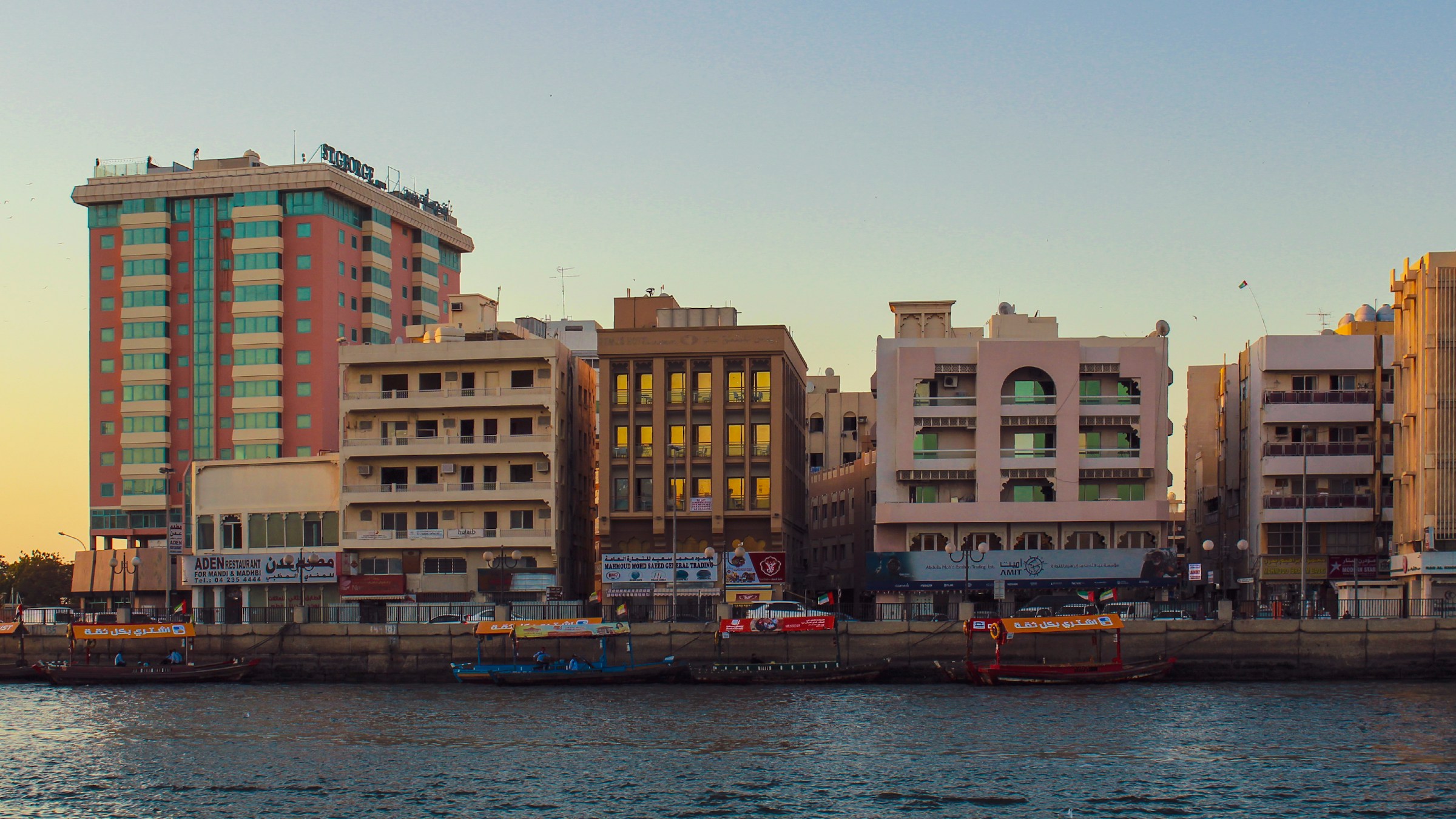
Stop 3 — Dubai Creek abra crossing. Walk to the Bur Dubai Abra Station (Textile Souk side, on the Bur Dubai bank of the Creek). The crossing is six minutes and costs AED 1 per person, paid in cash to the driver. Boats fill to capacity (about 20 people) and depart when full, so the wait is 1–10 minutes depending on time of day. Sit on the right-hand side for the best view heading to Deira.
Stop 4 — Deira souks. Once across, you’re in Deira. The two anchor souks are the Spice Souk and the Gold Souk, both in the same area a 5-minute walk from the abra landing. The Spice Souk is the better browse — saffron by the gram, frankincense, loose cardamom tea, dried limes, frankincense resin, oud wood. The Gold Souk is a spectacle even if you’re not buying; window-shopping is the entire point. Plan 60–90 minutes for both.
Stop 5 — A tea stop with a Creek view. A handful of small cafés on the Deira side serve karak chai with a Creek view for under AED 5. If it’s late afternoon, time this for sunset — the Creek is at its best in the half-hour after the sun drops behind the towers.
Stop 6 — Walk the Creek edge for 15 minutes. The single most underrated view in Dubai is the 800-metre stretch of Creek-side walkway on the Deira bank, looking back at Bur Dubai and the abra traffic. Do this at sunset; the light makes the whole day make sense.
Total walking: about 2.5 km. Total time: 4 hours including stops, 3 hours if you move fast. The whole route is flat, stroller-friendly, and safe at all hours of daylight.
Old Dubai Walking Tour Stops: What To Actually Look At
The route above gives you the order and the timings. This section is for the moments that make the lanes stop being background.
Wind towers. The four-pronged towers rising above the flat roofs of Al Fahidi houses are early passive cooling. Wind hits the tower, is funnelled down into the house, and exits through openings near the floor. They predate electricity by centuries. The reason Al Fahidi is more comfortable than a modern glass building in the same heat is these towers.
The narrow lanes. Most of Al Fahidi is intentionally built for foot and donkey traffic. The lanes are 1.5–3 metres wide, with high coral walls and small wooden doors. Look for the door motifs: a single painted ring, two rings, three rings, sometimes with a date. They were the original address system.
The Textile Souk (Bur Dubai side). Smaller and calmer than the Deira souks, and easy to miss if you walk past it. Worth a 20-minute stop on the way to the abra station, especially if you want inexpensive scarves, pashminas, and fabric by the metre.
The abra traffic. A small detail that earns a minute of attention. The Creek still runs on abras — wooden boats, traditional design, in continuous operation since before the discovery of oil. Watch one cross and back; the rhythm of the boats is the rhythm the city had for 150 years.
The smell of the Spice Souk. Less a “thing to look at” than a thing to actually stand in. The shops are stacked high with burlap sacks; the air is cardamom, frankincense, and dried lime. It’s the only sensory overload in Old Dubai that doesn’t come from a megamall.
2 Old Dubai Walking Tours To Book If You’d Rather Not Go Alone
The self-guided route is the better value, but a guided tour earns its price if you want the cultural layer explained. These are the two bookable options worth your money in 2026.
1. SMCCU Heritage Tour (Al Fahidi). A 90-minute guided walk through Al Fahidi led by an Emirati guide, run by the Sheikh Mohammed Centre for Cultural Understanding — the official cultural centre for the Al Fahidi Historical Neighbourhood. The tour covers wind towers, courtyard houses, the cultural history of the area, and ends with an open Q&A about Emirati life, religion, and customs. Roughly AED 80–150 per person depending on the season [VERIFY-PRICE-2026]. Bookings run through the SMCCU website. This is the only official operator we’d recommend for Al Fahidi proper; most other “Old Dubai” tours are general city tours that spend 20 minutes in the lanes and call it the heritage part.
2. SMCCU Heritage Express (Creek + souks). A 2-hour version of the SMCCU walk that extends the cultural-explainer format across the Creek crossing and into the Deira souks. Same operator, same guides, broader geography. Better if you want one guided block that covers the full self-guided route. Roughly AED 120–180 per person [VERIFY-PRICE-2026]. Same booking path via the SMCCU site.
Both tours run in the morning; both fill on weekends, especially November–March. Book 2–3 days ahead in shoulder season, 1–2 weeks ahead in peak season. Friday morning tours are scarce — Friday is the Islamic congregational day, and many operators adjust schedules.
Skip the “Old Dubai + Dubai Frame + Creek + Souks” megatour packages sold by third-party platforms. They bundle the visit into 30 minutes of Al Fahidi plus bus transfers to the Frame, and the guide is rarely a specialist. The SMCCU walks are the only ones where the cultural context lands.
Old Dubai Walking Tour FAQ: 2026 Questions Everyone Asks
How long is the self-guided old Dubai walking tour? About 4 hours including stops, or 3 hours if you move at a brisk pace. The walk is roughly 2.5 km plus a 6-minute abra crossing. Add 60–90 minutes if you book the SMCCU heritage tour on the front end.
What is the best time of day for an old Dubai walking tour? Morning, ideally 9:00–11:00 AM. Al Fahidi gets hot and quiet after 1 PM, and the lanes are at their best when the galleries and cafés are open. November–March mornings are ideal; May–September mornings are still workable but the rest of the day should stay indoors.
Is the old Dubai walking tour safe? Yes, in daylight. The Al Fahidi lanes are well-trafficked, the abra stations are staffed, and the Deira souks are busy. Avoid the very late evening in the more industrial parts of Deira, and skip the back alleys entirely after dark. For a half-day self-guided walk, this is one of the safest routes in Dubai.
How much does the old Dubai walking tour cost if you do it yourself? Effectively free. The abra is AED 1 per person each way. The souks are free to walk. Al Fahidi is free to walk. A karak chai at a Creek-side café is AED 3–5. Total out-of-pocket for the self-guided version: under AED 20 per person.
Can you do the old Dubai walking tour with kids? Yes, and it’s one of the better things in Dubai for kids who can walk 2.5 km. The abra crossing is the highlight for most children; the Spice Souk is a sensory hit; the lanes of Al Fahidi are short and shaded. Avoid the noon start in summer — go at 8:30 AM and finish before lunch.
What should you wear for an old Dubai walking tour? Modest, breathable clothing that covers shoulders and knees — this is a heritage area, and the cultural norms are different from Dubai Marina. Lightweight trousers or a maxi skirt, a loose top, comfortable walking shoes. Sunscreen and a refillable water bottle in summer; a light layer in winter evenings.
Planning your first trip? The old quarter pairs naturally with Burj Khalifa on the same day — start at Al Fahidi in the morning, cross the Creek by abra, and finish at the Burj Khalifa sunset slot. See our Things To Do in Dubai 2026 guide [INTERNAL-LINK-PLACEHOLDER] for the full first-timer shape.